President Xi Jinping was on Thursday elevated as the "core leader" of China's ruling Communist Party, conferring on him a status similar to that of party founder 'Chairman' Mao Zedong that dilutes the three-decade-old collective leadership principle to avoid personality cult.

Shocks from Brexit could also hurt one of China's biggest export markets.

Amid souring ties, the president visited Beijing for three days. On his return to India, a hope of better ties has arisen, says senior correspondent R Rajagopalan, who travelled with Pranab Mukherjee to the Asian superpower.
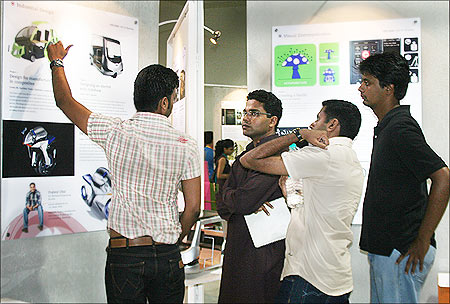
Funding Indian start-ups has slowed down.

'Xi's emphasis on enhancing conventional military deterrence capabilities, joint operations and power projection are likely to increase friction points with India as with other nations,' points out China expert Srikanth Kondapalli.

'The accusation that Pakistan risks losing sovereignty to China is emotive and has the potential to spread.' 'China will, however, remain intent on achieving its strategic ambitions of acquiring Gwadar port and securing a large chunk of Pakistan occupied Kashmir,' says former RA&W officer Jayadeva Ranade.

'India need to look beyond the economic prism.' 'China had no qualms in taking the Kashmir issue to the UN Security Council last year -- not once, but thrice -- thus violating Indian sensitivities,' observes China expert Srikanth Kondapalli.
The move comes a day after China lifted the 76-day lockdown in Wuhan, where the pandemic originated. China's National Health Commission (NHC) on Thursday reported 63 new confirmed cases of the coronavirus, including 61 imported ones taking the total to 1,104 cases.

Powerful explosions tore through a warehouse storing hazardous chemicals in north China's major port city, killing at least 50 people and injuring over 700 others as the twin blasts sent fireballs, cars and containers raining down on panic-stricken residents.

Donald Trump on Wednesday started his maiden visit to Beijing with both sides inking deals worth $9 billion.

'China might soon have to seriously consider whether it prefers an Indo-US hyphenation to a Sino-Indian one.'

For a rising country like China with its sights set on global and regional power, any coming together of the US and India is the worst case scenario. Hence, China is concerned with the emerging equations between New Delhi and Washington, says Srikanth Kondapalli.
'China's opaque defence allocation processes are shrouded in mystery and have triggered security dilemmas among its neighbours and others,' notes China expert Srikanth Kondapalli.

Chinese astronauts Jing Haipeng, 50, and Chen Dong, 37, were blasted off into space by Shenzhou-11 (heavenly vessel) spacecraft.

'Problems will keep recurring unless China vows to resolve all outstanding issues between the two sides,' says Sana Hashmi.

As Chinese army incursions continue to recur, India has cautioned China that any disturbance of peace and tranquility in the border areas can vitiate the overall atmosphere of bilateral ties.
The country opened its airspace for all flights except for New Delhi, Bangkok and Kuala Lumpur on March 27.

Unlike in the past, Modi made candid, frank and direct remarks on his hosts by suggesting that the Chinese side is holding back on further improving relations, says Srikanth Kondapalli.

Considering Modi's style of practicing diplomacy, it is likely that a clear message would be conveyed to China that it is high time Beijing stops using its good relations with Pakistan as a pressure tactic against India. This is imperative not only for strengthening India-China relations at the bilateral level but also for maintaining stability at the regional level, says Sana Hashmi.

'While visits and personal meetings are useful, changes of strategic significance have occurred recently, with Beijing trying to take the lead which Modi must take note of.'
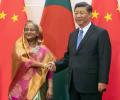
'Beijing is comfortable with Hasina's pragmatism -- perceived as 'pro-India', but staying out of Indian orbit and receptive to forging close ties with China and yet, siding with neither neighbour,' says Ambassador M K Bhadrakumar.
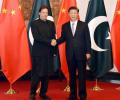
'The scheduling of Imran Khan's visit to Beijing and its focus on the J&K situation underscores that Beijing shares the Pakistani concern that tensions with India are only going to escalate further in the period ahead,' says Ambassador M K Bhadrakumar.

'Assuming the official defence allocations represent the true picture, the $142 billion figure still represents a phenomenal increase and surpasses that of Japan ($42 billion), India ($40 billion), South Korea ($33 billion) and several other Asian countries put together and shows that China is flexing its military muscle.'
The first priority for the new Tibetan administration in Dharamsala should be to look at Tibetan recruitment in the PLA, suggests Claude Arpi.
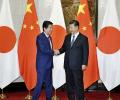
'Both Japan and China face a common challenge: How to deal with Trump.' 'The trade war with the US seems to have facilitated/hastened Abe's China visit, the first by a Japanese prime minister since 2011,' points out Dr Rajaram Panda.

Prime Minister Malcolm Turnbull's first State visit to India is an indication of the success of India's Act East Policy, says Dr Rahul Mishra.

The Chinese Communist Party's all important 19th Party Congress is just months away, and President Xi Jinping finds himself confronting unlikely challenges to his pre-eminent position, says former RA&W officer and China watcher Jayadeva Ranade.
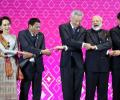
The prime minister also welcomed convergence of views between India and ASEAN for cooperation in the Indo-Pacific region.

No country has achieved a faster, deeper modern transformation than China, says former ambassador Kishan S Rana.


The massive earthquake in Sichuan struck at 9:19 pm (local time) on Tuesday and the epicentre was monitored at a depth of 20 km, state-run Xinhua new agency reported.
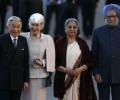
In recent years India-Japan relations have acquired rich economic content and strategic intents. Although the bilateral trade at $18 billion between the two countries is not very impressive and leaves much to be desired, the economic engagement between the two countries is both qualitatively and quantitatively noteworthy. India-Japan defence cooperation, however, has generated a lot interest among the strategic community in the context of rise of China. There has been a lot of speculation about India-Japan strategic partnership to hedge China, says Rup Narayan Das.

It was clear in Brunei at the 8th East Asia Summit that China doesn't want the South China Sea issue to even dominate the discussion, reports Sheela Bhatt, who is part of the prime minister's media contingent to the summit
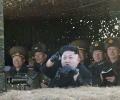
Whom will North Korean dictator Kim Jong-un kill next, and how?

China has relaxed its one-child policy and further freed up markets in order to put the world's second-largest economy on a more stable footing.

'Cyrus was always very different. He would think before acting.'

Srikanth Kondapalli on what to expect from the seventh BRICS summit meeting to be held in Russia in July.
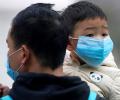
How China's all powerful Communist party bungled the response to the coronavirus crisis.
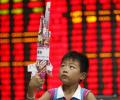
Some analysts argue that Beijing has been too cautious in lowering rates and freeing up cash in the banking system, keeping real interest rates too high given low returns on investment.

Despite vast differences in the way the media operates in the two countries, an India-China media forum will go a long way in improving understanding between the two countries, says Srikanth Kondapalli.
 © 2026 Rediff.com - Advertise with us - Disclaimer - Privacy Policy - Sitemap - Feedback - About us - Terms of use - Grievances